Frank Lloyd Wright Collection
Explore artifacts connected to one of America's most influential architects, including his signed autobiography and works by his apprentices.

Explore artifacts connected to one of America's most influential architects, including his signed autobiography and works by his apprentices.
Frank Lloyd Wright (1867-1959) was one of America's most influential architects, whose career spanned seven decades and produced more than 1,000 structures. Wright pioneered what he called "organic architecture," a philosophy that promoted harmony between human habitation and the natural world through design approaches that were integrated with the surrounding landscape.
Wright's work includes iconic buildings such as Fallingwater, the Guggenheim Museum, and the Unity Temple. His Prairie School architectural style, characterized by horizontal lines, flat or hipped roofs with broad overhanging eaves, and windows grouped in horizontal bands, became one of the first distinctly American architectural styles.
Beyond his architectural achievements, Wright was also a prolific writer, educator, and designer of furniture, fabrics, art glass, lamps, and other decorative elements. His influence extended far beyond architecture into broader design movements, particularly mid-century modernism.
This collection brings together artifacts that connect to Wright's legacy, including his signed autobiography, works by his apprentices, and educational tools that influenced his design philosophy.
Frank Lloyd Wright is born on June 8 in Richland Center, Wisconsin.
Wright's mother introduces him to Froebel blocks, which would profoundly influence his architectural thinking.
Wright moves to Chicago and begins working for architectural firm Adler & Sullivan.
Wright establishes his own architectural practice and begins developing his Prairie School style.
Wright travels to Europe and publishes the Wasmuth Portfolio, introducing his work to European architects.
Wright begins construction of Taliesin, his home and studio in Spring Green, Wisconsin.
Wright establishes the Taliesin Fellowship, an apprenticeship program for aspiring architects.
Wright begins construction of Taliesin West in Scottsdale, Arizona, as a winter home and school.
The revised and expanded edition of Wright's autobiography is published by Duell, Sloan and Pearce.
Frank Lloyd Wright dies on April 9 at age 91, leaving behind an unparalleled architectural legacy.
A signed first edition of Wright's autobiography from 1943, featuring his distinctive red square signature.
View Details
From the series Wright collected in 1913, showing the direct influence of Japanese art on his design philosophy.
View Details
A small vase created by one of Frank Lloyd Wright's apprentices at Taliesin, showing his influence on other artists.
View Details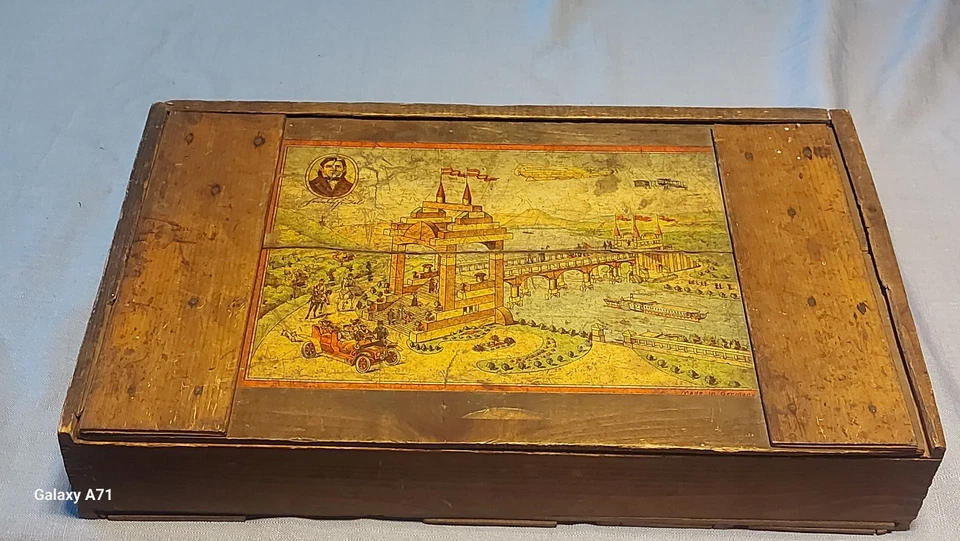
Educational toys that influenced Wright's design philosophy and approach to geometric forms.
View Details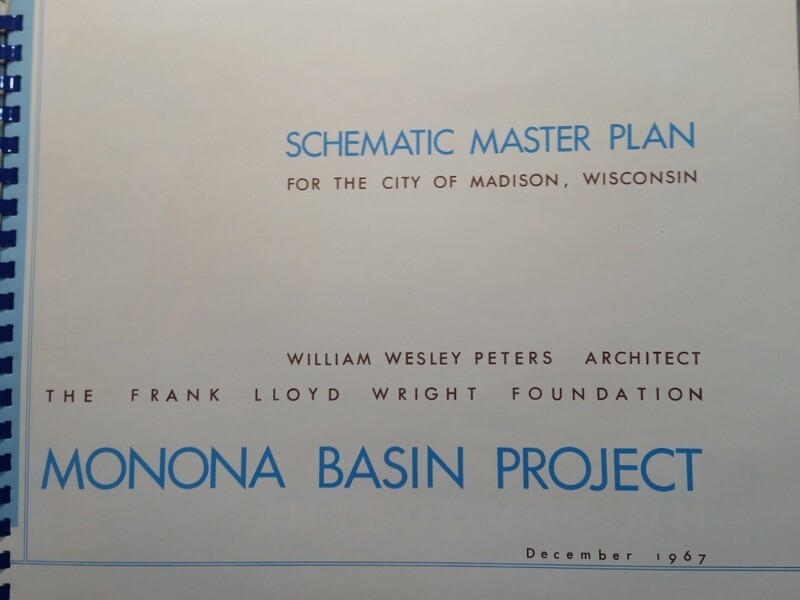
William Wesley Peters' 1967 master plan continuing Wright's vision for Madison's waterfront development.
View Details
A unique display featuring Wright's cut autograph and First Day of Issue commemorative stamps from Spring Green, WI.
View DetailsWright believed that architecture should be designed in harmony with humanity and its environment, a philosophy he called "organic architecture." This approach emphasized that buildings should appear to grow naturally from their surroundings, using materials and forms that connected to the landscape.
Wright approached each building as a unified whole, designing not just the structure but also the furniture, light fixtures, textiles, and even tableware. This comprehensive approach ensured a cohesive aesthetic throughout his projects.
Influenced by his childhood experiences with Froebel blocks, Wright used geometric abstraction as a fundamental design principle. He reduced natural forms to their geometric essence, creating patterns and structures based on simple shapes and mathematical relationships.
Wright often designed spaces with alternating feelings of compression (low ceilings, narrow passages) and release (open, expansive rooms), creating a dynamic experience as one moved through his buildings.
Particularly in his Prairie School designs, Wright emphasized horizontal lines to echo the flat, expansive landscape of the American Midwest. This was achieved through long, low rooflines, horizontal bands of windows, and terraces that extended outward from the main structure.
Wright preferred materials in their natural state, using wood, stone, and brick in ways that highlighted their inherent qualities rather than disguising them.
Wright's buildings often blurred the distinction between interior and exterior spaces through the use of large windows, terraces, and natural materials that continued from outside to inside.
Interested in a hands-on experience inspired by Wright's design philosophy? We offer Frank Lloyd Wright-themed workshops and programs for teams and groups.